
Duis mollis, est non commodo luctus, nisi erat porttitor ligula, eget lacinia odio sem nec elit. Aenean lacinia bibendum nulla sed consectetur. Praesent commodo cursus magna, vel scelerisque nisl consectetur et. Sed posuere consectetur est at lobortis.
NOTE: THIS IS THE KINDLE VERSION.
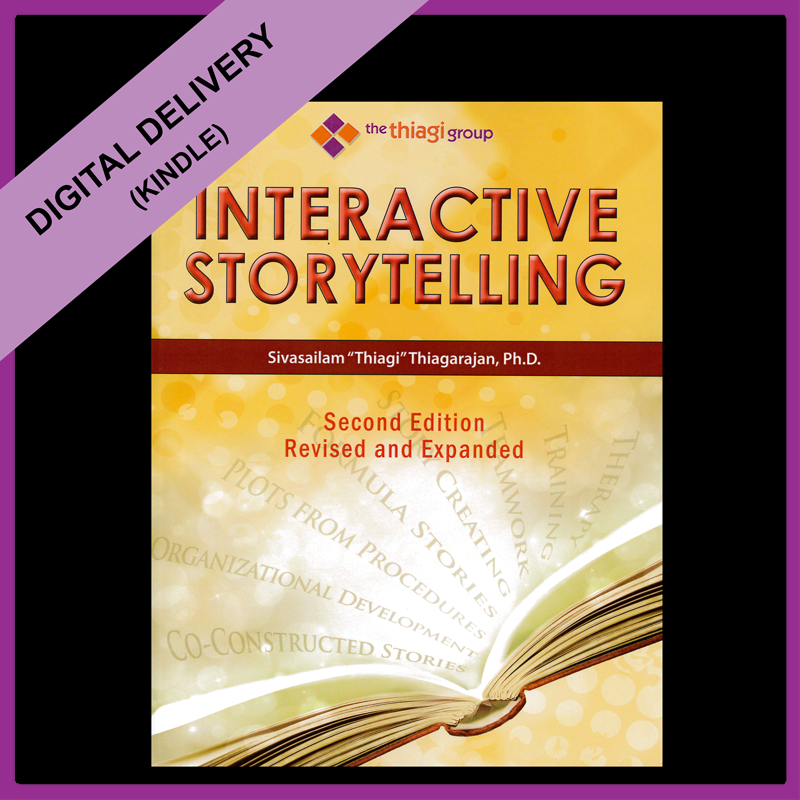
Storytelling is a powerful tool for trainers. However, traditional storytelling encourages the participants to become passive listeners. In contrast, interactive storytelling encourages them to interact with the stories and with each other. Different types of interactive storytelling techniques invite the participants to create their own stories and share them with each other. Even when the stories come from the facilitator, the participants modify the stories, change the beginning or the ending, change the characters or the setting, expand or shrink the stories, make decisions at critical junctures, analyze the stories, and roleplay them. The result: More engagement during the session and more learning after the session.
>>BACK TO STOREFRONT

NOTE: THIS IS THE ePUB VERSION.
The Leadership Story is a very short book that explores how context, perspective, and the distance of time affect how we recognize leadership in others. The first of several tiny volumes, leadership is viewed more as a narrative constructed by others than the application of skills, abilities, and traits originating from the leader. In other words, the real difference is in the stories told about that leader and how those stories become ingrained in the culture—whether that culture is within a small company, a large country, or the entire universe. The book looks at how context, perspective, and time become the narrative components that enable leadership stories to be told, adapted, and perpetuated throughout a culture. If story is meaning, and leadership is a story we tell, then how we understand those stories and how we convey those stories becomes so much more important than the knowledge, skill, and ability leaders have. Examples in the book include the story of John Tyler and how he became the first US Vice President to elevate to the Presidency, how Jimmy Carter reshaped how the role of the Vice President was perceived, and how William McKinley tried to avoid the Spanish-American War. The book also asks whether Neville Chamberlain really was an appeaser? Did Gerald Ford do the right thing pardoning Richard Nixon? And, more.

NOTE: THIS IS THE KINDLE VERSION.
The Leadership Story is a very short book that explores how context, perspective, and the distance of time affect how we recognize leadership in others. The first of several tiny volumes, leadership is viewed more as a narrative constructed by others than the application of skills, abilities, and traits originating from the leader. In other words, the real difference is in the stories told about that leader and how those stories become ingrained in the culture—whether that culture is within a small company, a large country, or the entire universe. The book looks at how context, perspective, and time become the narrative components that enable leadership stories to be told, adapted, and perpetuated throughout a culture. If story is meaning, and leadership is a story we tell, then how we understand those stories and how we convey those stories becomes so much more important than the knowledge, skill, and ability leaders have. Examples in the book include the story of John Tyler and how he became the first US Vice President to elevate to the Presidency, how Jimmy Carter reshaped how the role of the Vice President was perceived, and how William McKinley tried to avoid the Spanish-American War. The book also asks whether Neville Chamberlain really was an appeaser? Did Gerald Ford do the right thing pardoning Richard Nixon? And, more.

NOTE: THIS IS THE EPUB VERSION.
Ready To Use
The book begins with 10 ready-to-use training games on these topics:
Improving Human Performance
Storytelling Techniques
Listening Skills
Resolving Conflicts
Facilitation Techniques
Leadership Strategies
Building Trust
Changing Attitudes
Teamwork Techniques
Small-Talk Techniques
>>BACK TO STOREFRONT

NOTE: THIS IS THE KINDLE VERSION.
Ready To Use
The book begins with 10 ready-to-use training games on these topics:
Improving Human Performance
Storytelling Techniques
Listening Skills
Resolving Conflicts
Facilitation Techniques
Leadership Strategies
Building Trust
Changing Attitudes
Teamwork Techniques
Small-Talk Techniques
>>BACK TO STOREFRONT
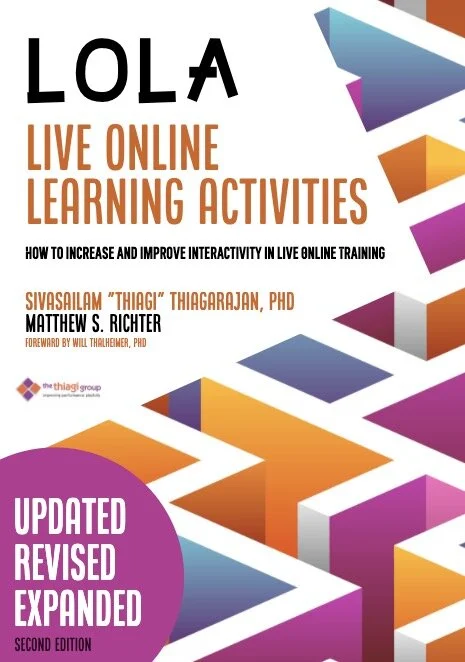
A major disadvantage of Live Online Training— traditionally called webinars or virtual training— is the lack of interactivity. Live Online Learning Activities (LOLAs) increase and improve interactivity during your live online training. LOLAs require and reward the participants to actively process, recall, analyze, and apply the training content. LOLAs can be used during the entire online session, or applied to different parts of it. Use LOLAs to transform your live online sessions from a data dump to an engaging exercise!
The book provides detailed instructions for conducting 55 different LOLAs and reusing their templates to instantly design your own LOLAs.
This is the 2nd edition. With a dozen brand new LOLAs added to the updated and revised other activities, a new chapter on LOLA JOLTs, current technologies and platforms reflected in all LOLAs, added chapters on designing, conducting, and choosing LOLAs, feature comparisons between the different popular platforms, and so much more.
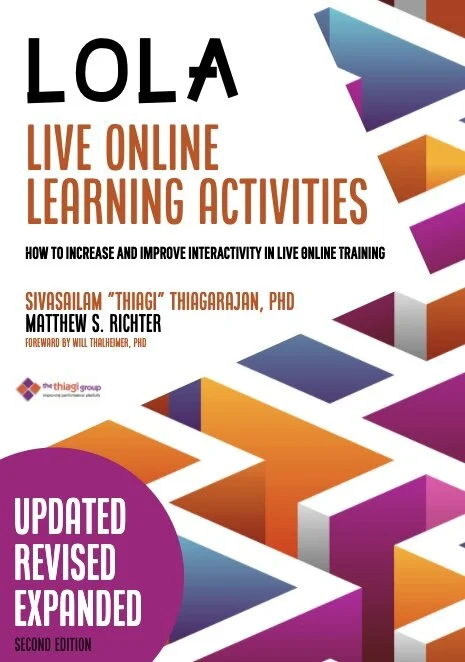
A major disadvantage of Live Online Training— traditionally called webinars or virtual training— is the lack of interactivity. Live Online Learning Activities (LOLAs) increase and improve interactivity during your live online training. LOLAs require and reward the participants to actively process, recall, analyze, and apply the training content. LOLAs can be used during the entire online session, or applied to different parts of it. Use LOLAs to transform your live online sessions from a data dump to an engaging exercise!
The book provides detailed instructions for conducting 55 different LOLAs and reusing their templates to instantly design your own LOLAs.
This is the 2nd edition. With a dozen brand new LOLAs added to the updated and revised other activities, a new chapter on LOLA JOLTs, current technologies and platforms reflected in all LOLAs, added chapters on designing, conducting, and choosing LOLAs, feature comparisons between the different popular platforms, and so much more.
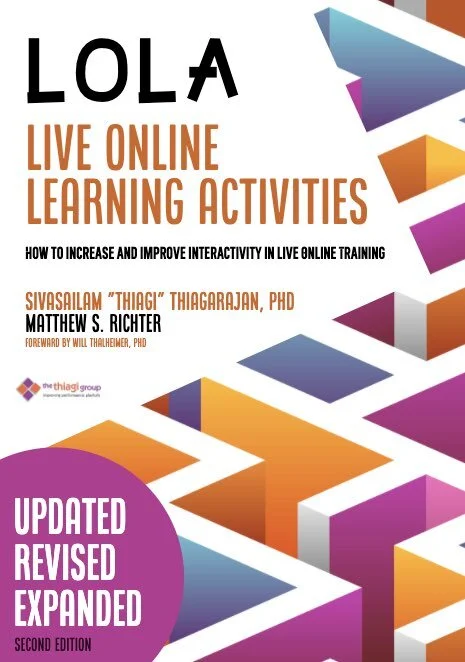
A major disadvantage of Live Online Training— traditionally called webinars or virtual training— is the lack of interactivity. Live Online Learning Activities (LOLAs) increase and improve interactivity during your live online training. LOLAs require and reward the participants to actively process, recall, analyze, and apply the training content. LOLAs can be used during the entire online session, or applied to different parts of it. Use LOLAs to transform your live online sessions from a data dump to an engaging exercise!
The book provides detailed instructions for conducting 55 different LOLAs and reusing their templates to instantly design your own LOLAs.
This is the 2nd edition. With a dozen brand new LOLAs added to the updated and revised other activities, a new chapter on LOLA JOLTs, current technologies and platforms reflected in all LOLAs, added chapters on designing, conducting, and choosing LOLAs, feature comparisons between the different popular platforms, and so much more.

NOTE: THIS IS A PDF EBOOK, OFFERED AT A REDUCED PRICE FROM THE PAPER VERSION. UPON ORDERING, YOU WILL RECEIVE A DOWNLOAD LINK LASTING JUST 24 HOURS. SO DOWNLOAD IMMEDIATELY. EMAIL US AT MATTHEW@THIAGI.COM IF YOU HAVE ANY DIFFICULTIES.
A jolt is an experiential learning activity that illustrates one or more important learning points. A few important characteristics of jolts are:
Jolts last for a very short period of time
Jolts provide participants with insights rather than skills
Jolts produce emotional effects
Some jolts require interaction among participants
All jolts must be followed by a debriefing
NOTE: THIS IS THE EPUB VERSION.
Storytelling is a powerful tool for trainers. However, traditional storytelling encourages the participants to become passive listeners. In contrast, interactive storytelling encourages them to interact with the stories and with each other. Different types of interactive storytelling techniques invite the participants to create their own stories and share them with each other. Even when the stories come from the facilitator, the participants modify the stories, change the beginning or the ending, change the characters or the setting, expand or shrink the stories, make decisions at critical junctures, analyze the stories, and roleplay them. The result: More engagement during the session and more learning after the session.
>>BACK TO STOREFRONT